Likely
At the pools
Everyday life
See the day tripGuides
Language
Currency
Check open spotsfrom $53 · no cancel feeInteractive tick list
Your list · 8 items
Tap to check items off; your progress is remembered on this device.
0 / 8 ready
You are all set. Only the date and the number of travellers are left to choose.
Claim a spotMost visitors meet fish and sunlight, not tigers. This page sorts what the official sources actually say about birds, elephants, a tiger track, monkeys and the pools, and lists the manners that keep visitors and animals safe.
Editorial team, erawanwaterfalltour.quest · Updated November 12, 2026 · Quick read: 7 min
Summary view
Erawan National Park animals make more sense once you see where the park sits. According to the Department of National Parks, Erawan belongs to Thailand's western forest, which covers more than 18,720 square kilometres and has two World Heritage forests, Huai Kha Khaeng and Thung Yai Naresuan, at its core.1 That means the park is one fragment of a vast, connected habitat, and the creatures that live in the big forest can also appear at its edges, including near the park.
The department's own descriptions of the park show the small end of the scale first. Its pictures include a small orange-bellied flowerpecker, shown as a splash of colour in the Erawan forest.5 It also shows vivid red champagne mushrooms that grow easily beside the falls,6 and cave crickets, presented as the secret life of the park's dark caves.7 None of these needs more than patience and a slow walk to appreciate.
So the honest list of Erawan animals is a layered one: birds and fungi visitors can find by the water, cave creatures that most people never see, fish in the pools, and large mammals that live deeper in the forest and rarely come near the trail. No official page we read gives a species checklist for the park, and we will not invent one. What follows is what the sources do say, in descending order of how likely you are to notice it.
What the sources name
| Life | What the source says | Source |
|---|---|---|
| Flowerpecker | An orange-bellied bird shown as a colour of the forest5 | Park authority |
| Champagne mushroom | Bright red, easy to find by the falls6 | Park authority |
| Cave cricket | Mysterious life in the dark caves7 | Park authority |
| Fish | Gently nibble at your feet3 | TAT |
| Wild elephants | Use feeding routes at the boundary2 | Park authority |
| Tiger | A footprint found in 20262 | Park authority |
No official page we read lists monkeys, snakes or a species checklist for the park.1
Visitors who type Erawan National Park elephants into a search box often expect to see elephants at the falls. They will not. TAT's safety guidance says plainly that national parks do not provide organised elephant-watching activities, and that visitors must follow park rules, stay on marked trails and obey officials.12 Wild elephants live in the forests of this region, but a day at the pools is not a safari, and nobody should plan around a sighting.2
The park authority's own reporting shows how close the wild animals are. When rangers found a tiger footprint near the park boundary on 6 September 2026, they described the spot as a feeding route used by wild elephants.2 That sentence tells you that elephants pass through the border zone of the park, but it places them away from the visitor trail. TAT also warns that dawn and dusk are peak hours for elephants and other animals, and says to avoid isolated spots then.13
The elephants most visitors meet are in camps outside the park. TAT said in 2020 that more than 3,000 elephants work in the tourism business or are reared nationwide, living in 250 elephant camps in 22 provinces.14 It also set up a strategy called Elephant Care Tourism,15 and noted that camp elephants do not know forest life and can be a hazard if they wander into settlements.16 Some day tours combine Erawan with a camp, and each listing describes its own elephant activities.
The most striking wildlife news from the park is recent. On 6 September 2026 park patrol officers found a large tiger footprint on the park boundary near Ban Thung Kang Yang, on a feeding route used by wild elephants.2 The print measured 13 centimetres both in width and length, and the pad was 9.5 centimetres wide.8 Officers found no carcass or trace of a hunt around it.9 The news came from the department's own press office, which is the source we use here.
The park read the find as good news for the forest. It called the tiger sign an important indicator of a healthy ecosystem in the western forest and Erawan, where natural prey animals have increased.10 The authority also treated it as a safety question for neighbouring villages, so it planned camera traps at risk points and drone surveys from the air to judge the direction the tiger was moving.11
For a visitor this is context, not a warning label. The footprint was on the boundary of the park, near a village, and not beside the swimming pools. Day visitors who stay on the marked paths during opening hours are the people the park's rules are written for. Stay quiet, keep to the trail, keep groups together and leave isolated corners to the rangers, especially at dawn and dusk when wildlife is more active.
Before the trail
A few quick rules for the most common situations.
If A monkey or bird comes close
Do not feed it
TAT lists not feeding wildlife among its safety tips.4
If I hear something large nearby
Stay calm and quiet
Avoid shouting, sudden noises or movements.17
If An elephant is on the road
Stop far away and do not honk
TAT says to stop at least 30 metres away.18
If It is dawn or dusk
Avoid isolated areas
Elephants and other wildlife are most active then.13
If I want an elephant experience
Choose a camp tour, not the park
National parks do not provide organised elephant-watching.12
Wildlife in practice
Likely
Everyday life
See the day trip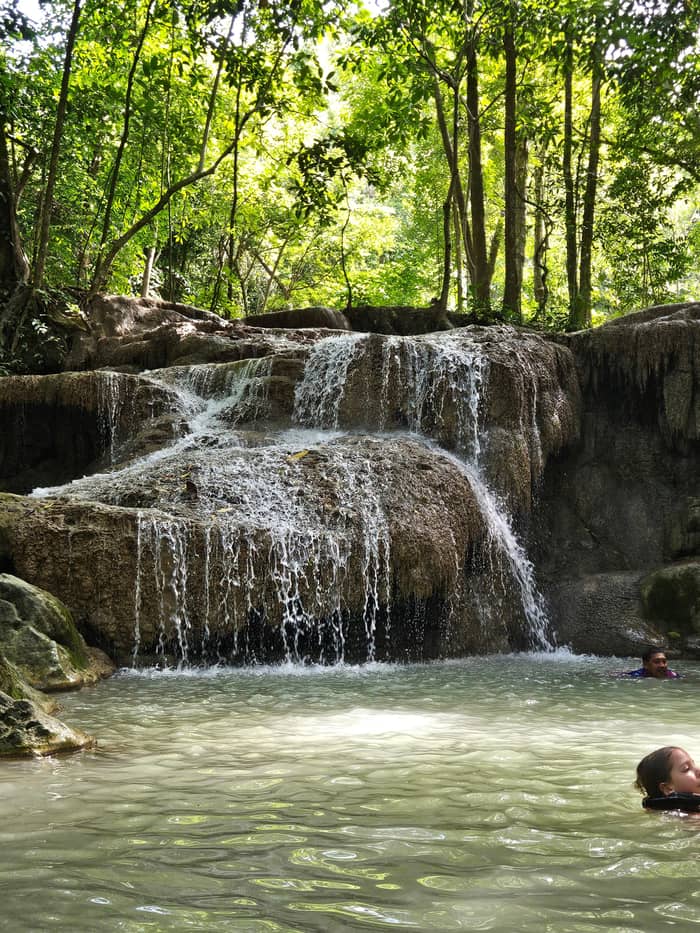
Look closely
Quiet corners
See the day trip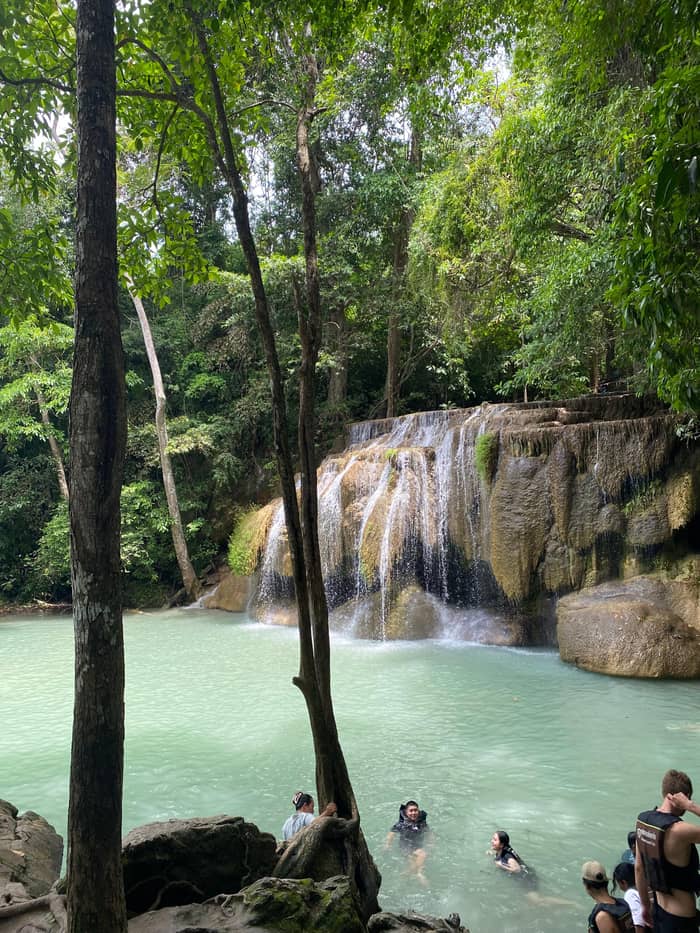
Not on the path
Rare and wild
See the day tripSearches for Erawan National Park monkeys deserve a careful answer. None of the official pages we read describes monkeys in this park, so we will not promise that you will see them or that they will approach you. What the sources do give is general wildlife advice that applies to any monkey, bird or squirrel: stay quiet and keep food sealed away so it does not draw wildlife.20 Zip bags closed, keep snacks out of sight and eat at a table rather than on the trail.
The rule that matters most is the simplest: do not feed. TAT's national park safety tips include not feeding wildlife.4 A department order about camping adds the reason behind food discipline, since smoky cooking near tents and lodging can draw wild animals that damage property or hurt visitors.25 A bag that is zipped and a snack eaten at a picnic table are the best protection for both you and the animals.
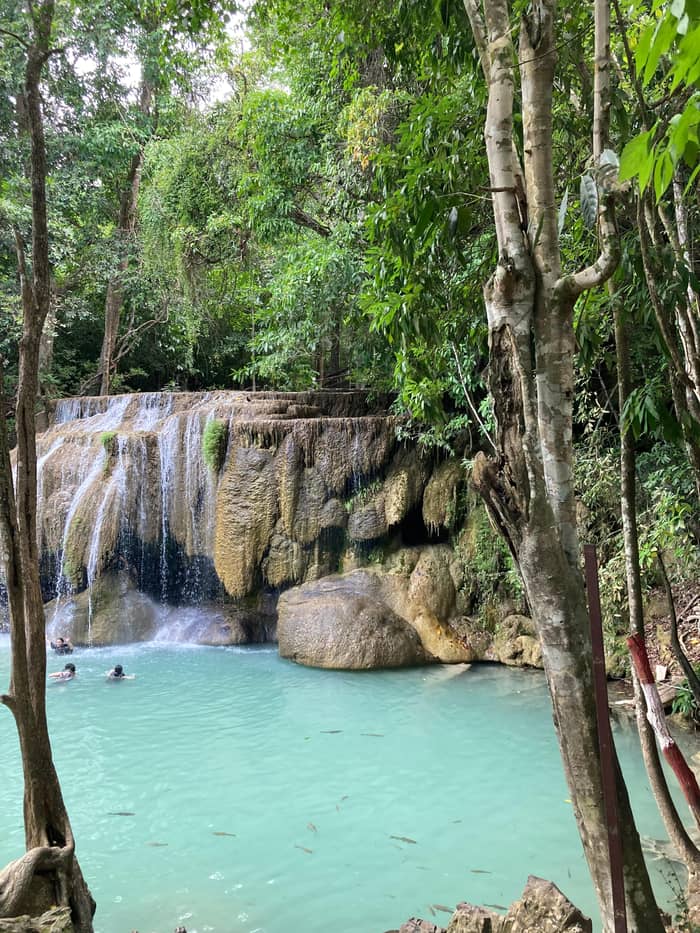
The fish deserve the same respect. The pools hold fish that, in TAT's words, gently nibble at your feet.26 They are part of the pool, so look, enjoy the tickle and leave them alone, and keep your feet still for a moment if you want the full effect. If any animal approaches you for food, do not chase it, shout at it or take close-up photographs. Move away slowly and tell a ranger when you pass the park office.
How the tiger report unfolded
On patrol
Officers found a large print on the boundary while patrolling.2
The measurement
The print measured 13 centimetres each way, the pad 9.5.8
The check
Officers found no trace of a kill around the print.9
The reading
The park called it an indicator of a healthy ecosystem.10
The plan
Camera traps and drone surveys were planned.11
An encounter with a large animal is not something to plan for, but TAT has published guidance for exactly that moment. Stay calm and quiet, and avoid shouting, sudden noises or movements that may startle an elephant.17 Do not run or turn your back, and retreat calmly to give the animal space.27 The same page asks visitors not to take close-up photographs and not to follow elephants.22 Keep your group together and let the animal choose its own path.
Learn the warning signs before you need them. TAT's warning signs of an aggressive elephant are stiff, wide-spread ears, a raised tail, a trunk held still or striking the ground, and a fixed stare, and it says to leave straight away.19 When the animal is calm, the page says it will look relaxed and uninterested in people, so watch from a long distance and make no attempt to approach for a better view.
The advice for drivers is just as clear. In wildlife zones TAT tells drivers to stop at least 30 metres from elephants,18 and to avoid honking or sudden noises. Drive slowly on forest roads, particularly in the early morning and the late afternoon, and keep the radio off and the windows up near any animal you see. A vehicle that stops to watch an animal can cause a queue behind it. Report any sighting on the road to park officials, who know the area and can decide what to do.
Video
MagellanTV on YouTube · The video waits until you tap play to load.
Signs of Aggression: Ears stiff and spread wide, tail raised, trunk still or striking the ground, and intense staring. Leave the area immediately if you observe these warning signs.
Behind the scenes the park is policed. On 2 February 2026 rangers patrolling the Sai Yok district part of the park found a man with 60 wild-fowl snares and a speaker.28 He received an administrative fine of 1,000 baht and all his equipment was seized,29 and the rangers told him that carrying hunting or trapping gear into a national park is against the law.23 The case shows that the wildlife here is under real pressure from poachers as well as from tourism.
Visitors can help by following the basics: stay on marked trails, carry out all rubbish and never bring in equipment that traps or kills. The ban on single-use plastic and foam covers all 155 national parks,24 and discarded wrappers can harm wildlife in any forest, however small they look. A small reusable box and a bottle of water are all you need for most of the day, and the rubbish you do not create is the rubbish nobody has to carry out.
Health in the forest means insects first. The US CDC's bite-prevention advice is full-length clothing, a hat and a suitable repellent,21 and it suggests clothing and gear treated with permethrin, never applied directly to skin.30 It names the provinces bordering Myanmar, Cambodia and Malaysia as the main malaria areas and tells travellers to talk to a doctor.31,32 Plan ahead and ask about your own route.
FAQ
TAT describes fish that gently nibble at your feet in the emerald-green pools.3
TAT says walk away slowly, never run, and leave the animal room.27
Some day tours combine Erawan with a camp, and each listing describes its own activities.
Sources
Further reading
Planning a day at Erawan Falls? Ask a real person here.