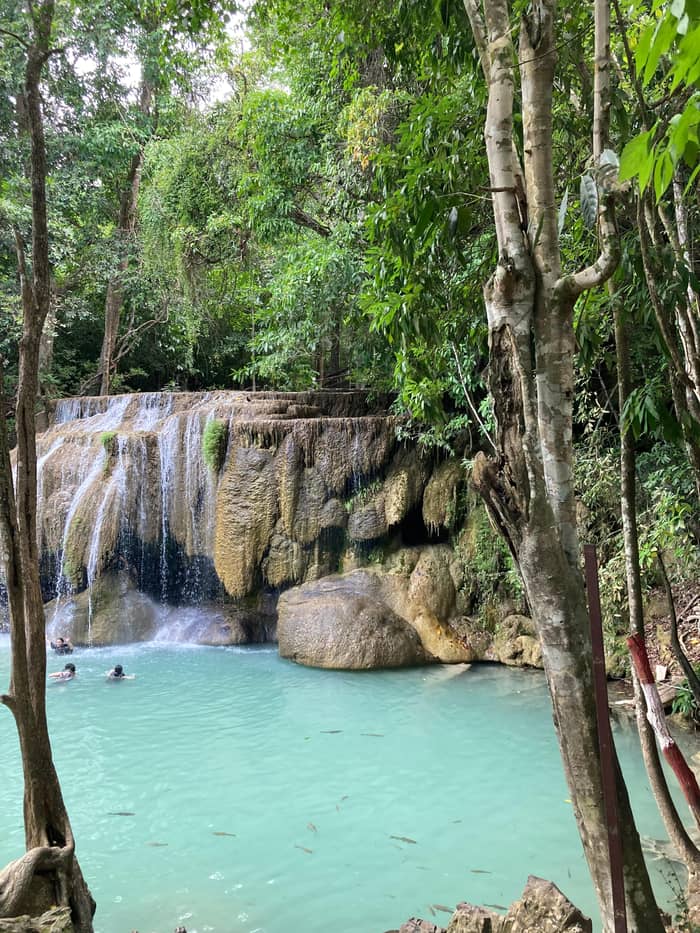
Easy
The quick dip
For a short stop
- WhereThe lower pools
- FloodsStill open3
- TimeA few minutes
Guides
Language
Currency
Check open spotsfrom $53 · no cancel feeInteractive tick list
Your list · 8 items
Tap to check items off; your progress is remembered on this device.
0 / 8 ready
You are all set. Only the date and the number of travellers are left to choose.
Claim a spotThe short answer is yes, in the pools along the trail. The long answer covers the fish that nibble, the floods that close the upper tiers, the plastic ban, the smoke rule and what to do about lockers and valuables.
Editorial team, erawanwaterfalltour.quest · Updated November 12, 2026 · Quick read: 7 min
Summary view
Yes, you can swim in Erawan National Park, and swimming is the reason many people climb the trail. The government tourism directory describes the waterfall as a cascade of 7 tiers in which each level is a basin where visitors can go into the water.1 The park authority describes the same staircase as steps of limestone with emerald green pools between them,5 so the swimming places are built into the structure of the falls rather than being a separate lake.
The authority singles out one pool in particular. For tier 5 it describes a large, cool pool whose rocks have been polished by time.6 That description suggests a place with room to swim and sit, which is useful when the lower pools are crowded. Nothing in the pages we read gives depths or tells you which pool suits weak swimmers, so the practical approach is to watch other swimmers, stay near the edge and keep within your limits.
Swimming here is a pleasure rather than a sport. The water runs over limestone and between rocks, and the pools sit one above another along a path that visitors also use on foot. Treat each pool as a place to cool off between climbs, bring a swimsuit that stays on, and do not expect a long swim in any one place. A short, careful dip at each stop is how most of the day is spent.
Rules at a glance
| Topic | Rule or fact | Source |
|---|---|---|
| Swimming | Each level has a basin visitors can enter1 | Tourism directory |
| After floods | Only the lowest open tier may be open3 | Park authority |
| Plastic | Single-use plastic and foam are banned4 | TAT |
| Fine | A maximum of 100,000 baht13 | TAT |
| Cooking | No smoky cooking near tents and lodging14 | Park department |
| Feeding wildlife | To be avoided11 | TAT |
All rows come from official pages; none of them sets a rule for the fish.11
The Erawan National Park fish are among the most talked-about features of the pools. Tourism Authority of Thailand's newsroom describes a dip in emerald pools where fish gently nibble at your feet.10 The word gently matters: the sensation is a ticklish one rather than a bite, and the first surprise usually turns into laughter. Keep your balance on the slippery rock while you laugh.
A few manners keep it pleasant. TAT's safety tips for national parks include not feeding wildlife and keeping to marked trails.11 We found no official page that sets a special rule for the fish of Erawan, so the sensible approach follows the general advice: do not feed them, do not try to catch them and do not splash sunscreen or lotion into the pool. The fish are part of the pool, and the pool is part of a protected park.
If the nibbling is too much, step into a shallower stretch or sit on a rock out of the water for a moment. The fish gather where people stand still, so a visitor who keeps moving will notice them less. Keep jewellery, rings and watches off before getting in, because a pool of fish and rock is a poor place to lose a small item, and carry a towel for drying your feet before you put shoes back on.
The pools are not available in the same way all year. The authority notes that every tier is normally open, with flooding as the exception that leaves tier 2 alone.3 If you travel in the rainy months, swimming at the upper pools is a matter of luck and of the day's conditions, and the lower pool remains the dependable choice. The same authority notes how forcefully the water drops from the elephant-head rock in the wet season.16
Weather data show how quickly the picture changes. September brings 12 wet days of 2.5 mm or more at the Kanchanaburi station, the nearest long record, against 0 in January.12,12 Anybody planning a September swim should expect strong, brown-tinged water on some days and a possible closure on others, whereas January water is usually calmer. The chart below uses the same station for six months of the year.
Air quality can also close the park. On 21 April 2026 the park chief closed the park to tourism and overnight stays, naming forest fires and haze and a fine dust average over 24 hours of 42.9 micrograms per cubic metre; it reopened on 22 April 2026.15,17,18 If your trip falls in the dry, hot season, phone the park office on 034-574-222 before you set out.7 Dry-season smoke is a slower-moving problem than a flood, but it can still upset a plan within a day.
Before you get in
Run through these questions at the edge of the first pool.
If The water is brown and fast
Stay out and look
The authority says floods can leave only the lowest tier open.3
If Many people are in the pool
Use another pool
Each level has its own basin, so walk up to the next one.1
If I am a weak swimmer
Paddle at the edge
The sources give no depth, so judge the water yourself and keep close to the shore.
If I smell smoke or the park is closed
Postpone
The park has closed for fires and haze, so phone first.15
If I am carrying food in plastic
Repack it
Single-use plastic and foam are banned in national parks.4
Swim styles
Easy
For a short stop
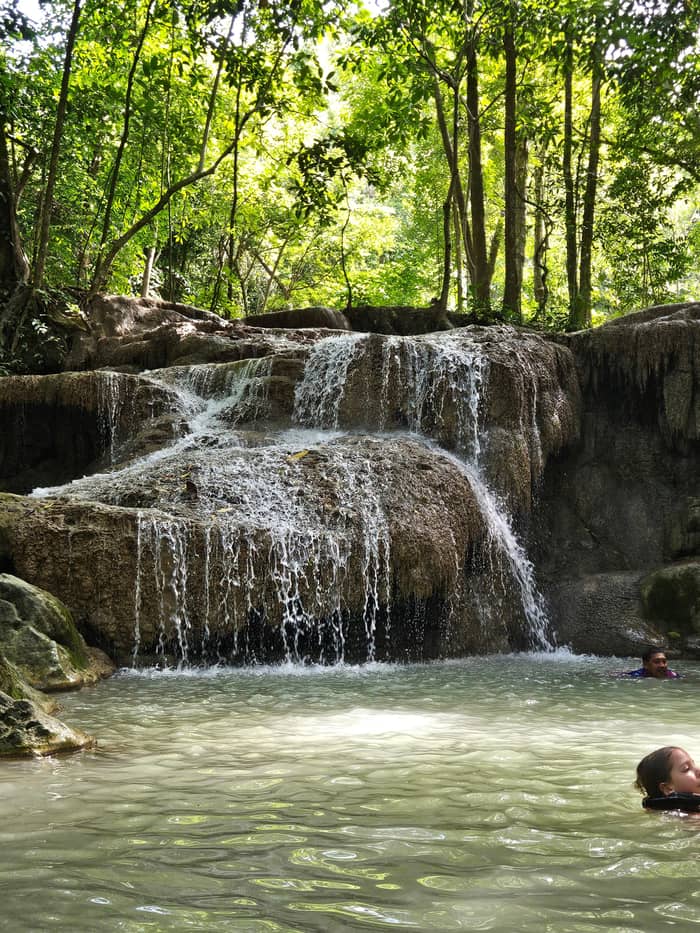
Calm
For a relaxed rest
See the day trip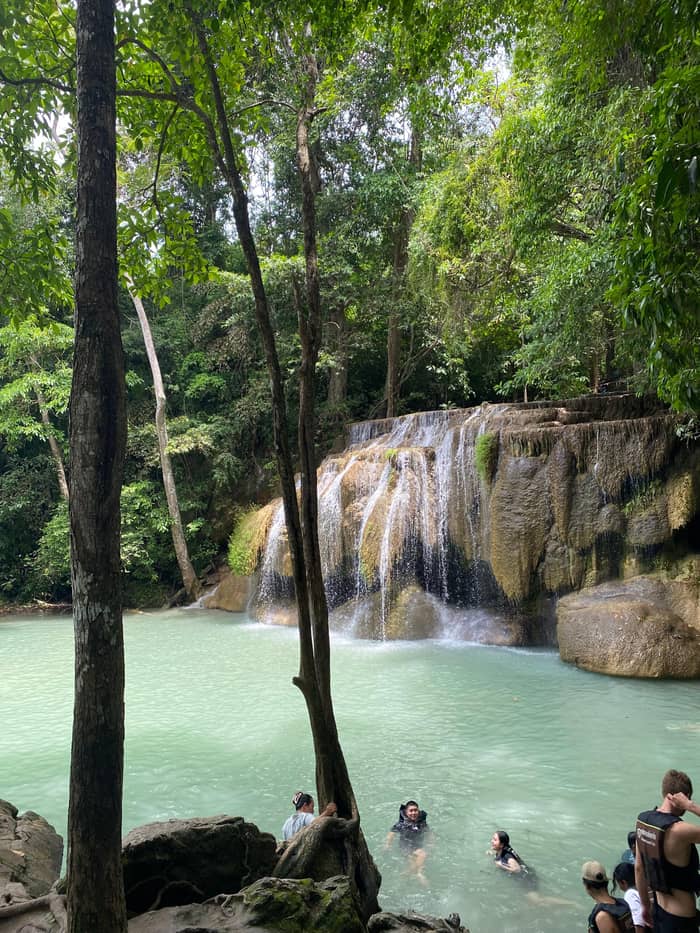
Fun
For the curious
See the day tripThe most important rule for a swimmer's bag is about plastic. Since 6 April 2022 all 155 national parks in Thailand ban bringing or using single-use plastics and foam containers.4 It covers plastic food containers, glasses, straws, spoons and forks, plastic packaging and foam containers,8 and under the National Parks Act the top penalty can reach 100,000 baht.13 Pack food in reusable boxes and bring a refillable bottle.
A second rule is about smoke and smell. Under a department order dated 2 July 2021, smoky or smelly cooking is banned beside tents and lodging in national parks; tea, coffee and instant noodles are exempt.14 The order gives two aims: sparing other campers, and stopping wild animals from being drawn by food smells into damaging property or hurting people.20 A day visitor is not camping, but the principle applies to any food that you carry.
Hunting and trapping equipment is a third rule. Rangers told a man caught with snares that taking hunting or trapping gear into any national park breaks the National Parks Act.21 Most visitors never think about this, but it is a reminder that the park is a protected area with real enforcement, and that TAT urges reading a park's regulations ahead of any visit. Rules change, so look again before every trip.22
A swim day in order
Arrival
Phone the office or look at its Facebook page.7
At the gate
Swap plastic wrapping for reusable boxes.8
First pools
The tourism directory says each level is a basin.1
Mid-climb
The authority calls it a big, cool pool.6
Return
Be out of the water before conditions change.3
Before closing
The directory lists closing at 16.00.9
Visitors often ask about Erawan National Park lockers, and none of the official pages we read lists any. The park authority's pages on the falls cover tiers, trails and the flood rule, the tourism directory gives hours and routes, and TAT's newsroom covers rules and safety, but none mentions storage. We will not repeat a claim from an unofficial blog, so the plan is to ask the park office on 034-574-222 before you travel.7
Until you hear otherwise, travel light. Wear your swimsuit under your clothes so that you do not need a changing room at the first pool, bring a small dry bag for the phone and a card, and leave watches, rings and anything you cannot afford to lose at your hotel. On a guided day trip, ask the guide before leaving the vehicle what can stay inside it, since the tour's own listing does not say.
Keep to a simple system on the trail. One small waterproof bag holds the phone, a card and a little cash. One towel stays dry at the bottom of a backpack. A change of shirt goes in a plastic-free pouch for the walk back, and a pair of sandals or water shoes comes along for the pools. That is enough for a visit of 1 hour at the park and 1 hour hiking and swimming, the time the small-group tour allows.
Video
Wanderlusting with Joe on YouTube · The video waits until you tap play to load.
avoiding close interactions, refraining from feeding wildlife, staying on marked trails, recognising signs of aggression, and remaining calm in unexpected encounters
Children enjoy the pools, but a careful adult should stay within arm's reach in the water. The sources give no age limits and no lifeguard information, so the responsibility is yours, and no sign will do the watching for you. Choose the shallow edges of the lower pools, watch the current after rain and be ready to leave the water the moment the flow looks stronger or browner than when you arrived. A child who tires quickly is better out of the water and on a rock with a snack than pushing on to the next pool.
Non-swimmers can still enjoy the park. The pools are places to sit and paddle, and the walk beside them is the main attraction. A visitor who stays on the path, takes a rest at the big cool pool and uses the stepped limestone as a place to sit will have a good day without going out of their depth. Wearing water shoes helps on wet, polished rock, and a hat protects against the sun.
Insects and heat need respect in this forest. The US CDC advises covering exposed skin with long sleeves, long pants and hats and using an appropriate insect repellent.19 Border provinces facing Myanmar, Cambodia and Malaysia, above all their rural forest, are the malaria zones in that guidance, which suggests a talk with a doctor first.23,24 Ask your doctor about your own route and dates well before you travel.
FAQ
Each level has a basin where the tourism directory says visitors can enter the water.1
TAT mentions fish that nibble at the feet of anyone standing in those pools.10
With floodwater about, tier 2 may be the sole tier open.3
The top penalty under the National Parks Act can reach 100,000 baht.13
None of the official pages we read lists lockers, so ask the park office on 034-574-222.7
TAT's safety tips for national parks include not feeding wildlife.11
A 2021 department order bans cooking with smoke or smell near tents and lodging, with tea, coffee and instant noodles excepted.14
Sources
Further reading
Planning a day at Erawan Falls? Ask a real person here.